

Why Writers Still Choose Paper Notebooks in a Digital World
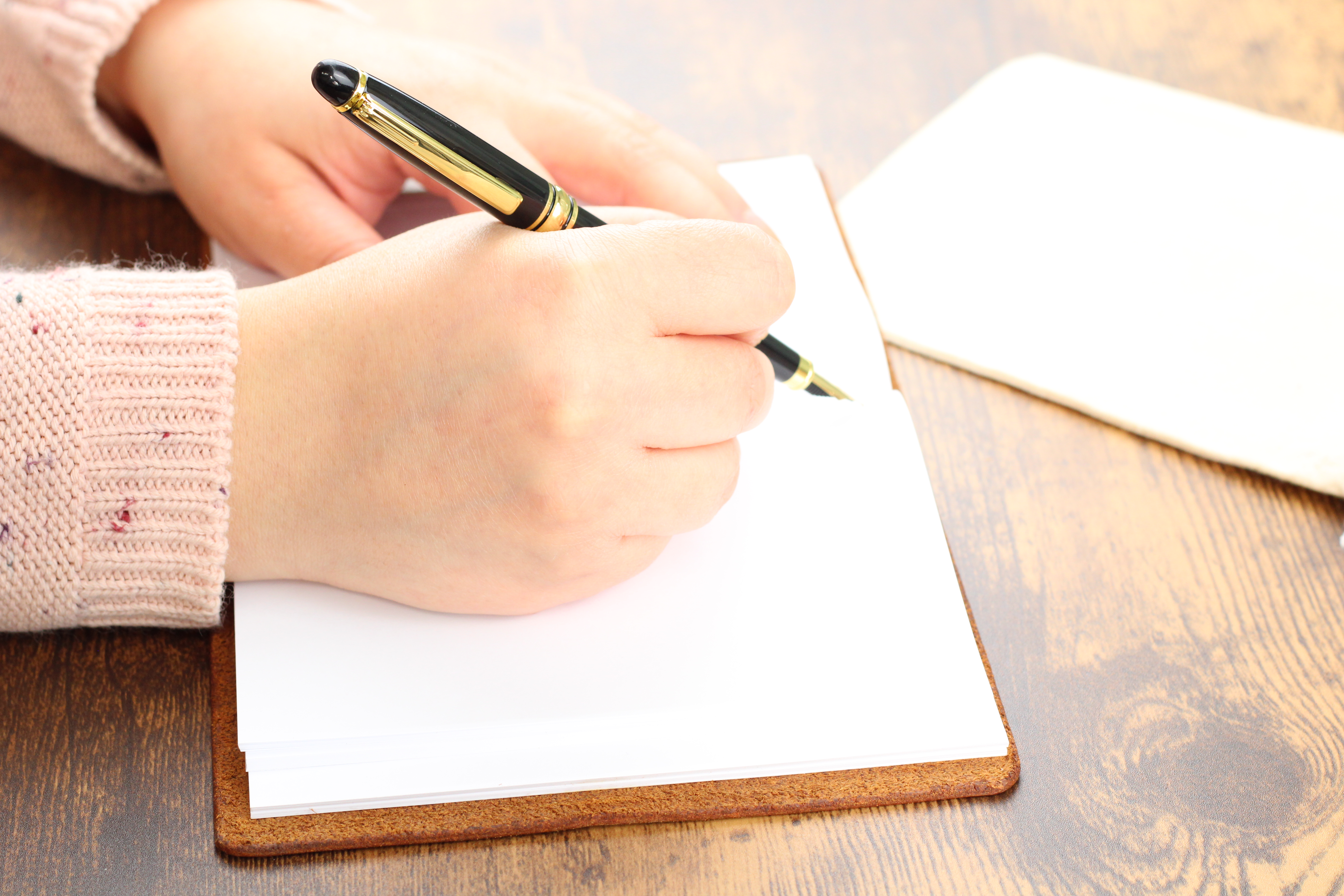
It would be easy to assume the paper notebook is a relic — a charming holdover kept alive by stationery obsessives and people who romanticise fountain pens. The data says otherwise. Notebook sales have held remarkably steady, and if you look at who's buying, a striking number are the very people who spend their working lives on screens: writers, editors, screenwriters, songwriters, academics and journalists. These are not technophobes. They own the apps. They still reach for paper. The question worth asking is why, and the answer turns out to have far more to do with how the brain works than with sentimentality.
At Burecho we make refillable leather journals by hand, so we talk to writers all the time — people who use our notebooks for first drafts, notes, and the messy thinking that never survives contact with a keyboard. This is what we've learned about why the paper notebook refuses to die.
Writing by hand changes how you think
The most persuasive reason isn't nostalgia — it's cognition. Handwriting is slower than typing, and that slowness is a feature, not a bug. Because you can't get every word down, your brain has to summarise, prioritise and rephrase on the fly. That extra processing is exactly what deepens understanding and memory. Studies of students taking notes have repeatedly found that those who write by hand recall concepts better than those typing verbatim, precisely because typing lets you transcribe without thinking.
For a writer, this matters enormously. A notebook isn't just a place to store sentences — it's a thinking tool. The friction of the pen forces you to commit, to choose one word over another, to feel the shape of a phrase before it's locked in. Many writers describe a first draft written by hand as looser, braver and stranger than one typed straight into a document, because the blank page carries none of the quiet pressure of a screen that expects finished prose.
No cursor, no autocorrect, no delete key
A screen is a relentless editor. The cursor blinks. The red underline nags. Autocorrect quietly rewrites your voice into something blander. Every sentence can be deleted and reworked instantly, which sounds like freedom but often becomes paralysis — you polish the first line forty times and never reach the second.
Paper removes all of that. You can't delete cleanly, so you cross out and carry on. The mess stays visible, and that visible mess is useful: a crossed-out word still tells you what you were reaching for. Writers talk about the paper notebook as a place where they're allowed to be bad first, where nothing is being judged or auto-saved or silently corrected. The permission to write rubbish is, paradoxically, what gets the good stuff onto the page.
One task, no notifications
Open a laptop to write and you've opened a machine designed to interrupt you. Email, messages, the browser tab you'll "just quickly check" — the device that holds your draft also holds every distraction in your life. A notebook does exactly one thing. It never pings. It never suggests you check something. It cannot show you a headline that ruins your afternoon.
For deep work — the long, uninterrupted stretches where real writing happens — that single-mindedness is priceless. A growing number of writers keep the notebook precisely as their distraction-free zone, drafting on paper in the morning and only moving to a screen to type up and edit. The notebook becomes the sanctuary; the computer becomes the workshop.
The page remembers where you were
There's a spatial memory to paper that screens flatten entirely. You remember that a particular idea was scrawled in the top corner of a left-hand page, near the coffee ring, a few pages after the train journey. That physical location becomes a hook your memory can grab. Flicking back through a notebook is a fundamentally different act from scrolling — you pass everything on the way, half-reading old entries, stumbling on a note you'd forgotten and suddenly seeing how it connects to today's problem.
Digital notes are searchable, which is genuinely useful, but search only finds what you already know to look for. A notebook lets you find what you weren't looking for. For creative work, those accidental collisions of old and new ideas are often where the best material comes from.
It will still open in twenty years
File formats rot. Apps get discontinued, subscriptions lapse, the note-taking service you trusted with a decade of ideas gets acquired and shut down. A paper notebook has no login, no update, no end-of-life. Open a good notebook in twenty years and it works exactly as it did on day one — which is more than you can say for most software.
This is part of why we make our covers to last. A well-built full-grain leather journal is a genuine long-term object; if you're curious about how long that kind of leather realistically survives, our piece on whether real leather is worth it makes the cost-per-year case, and our guide to what patina is explains why it looks better the longer you keep it. A notebook you'll still own in two decades treats your words as something worth keeping.
"But I'll lose it" — and other honest objections
Paper isn't perfect, and it's worth being straight about the trade-offs. You can lose a notebook. It doesn't back up to the cloud. You can't copy-paste from it, and you can't search it in a second. For some tasks — collaborative documents, anything you'll heavily revise, long-form typing — a screen genuinely wins, and no one serious about writing works on paper alone.
The realistic answer most writers land on is a hybrid: paper for thinking, capturing and first drafts; screen for editing, sharing and storing. The notebook is where ideas are born; the computer is where they're finished. Used this way, the "limitations" of paper stop being problems and become the whole point — it's the tool you reach for when you specifically want to slow down and think.
Why the notebook itself matters
If you're going to keep a paper practice, the object earns its keep. A cheap, floppy notebook that won't lie flat, whose cover curls and whose pages feather your ink, quietly discourages you from using it. A well-made one does the opposite — it invites you in. There's a reason writers get attached to a specific notebook and mourn when a model is discontinued.
Our refillable leather notebook cover is built around that idea: a full-grain veg-tan cover that outlasts the paper inside it, so when you fill an insert you simply drop in a new one and keep the cover you've broken in. If you're new to the format, our explainer on how the refillable insert system works walks through it, and if you're weighing sizes, our A6 versus A5 comparison will help you pick one you'll actually carry. The paper matters too — the wrong pen on the wrong stock ruins the experience, which is why we wrote up the best pens for leather-bound notebooks.
The quiet verdict
Writers don't choose paper because they can't cope with technology. They choose it because it does something screens can't: it slows the hand to the speed of thought, removes the machinery of judgement and interruption, and gives ideas a physical home that will still exist long after this year's apps are forgotten. In a digital world, that's not a step backwards. It's a deliberate, well-earned choice — and one worth making with a notebook good enough to keep. Browse our handmade leather goods or the premium Badalassi heritage collection if you're ready to start one.
Frequently asked questions
Is handwriting really better for memory than typing?
The research strongly suggests so for learning and recall. Because handwriting is slower, you are forced to summarise and process rather than transcribe word for word, and that extra effort helps the information stick. For capturing and developing ideas, most writers find paper genuinely more effective than a keyboard.
Do professional writers actually still use paper notebooks?
Many do, often alongside their computers. It is common to draft, brainstorm or capture ideas on paper first, where there are no distractions or autocorrect, and then move to a screen for editing and sharing. The two tools do different jobs rather than competing.
Isn't a note app more practical than a notebook?
For searching, backing up and sharing, yes. For thinking, focus and permanence, paper often wins. Most people who keep a notebook use both: the notebook for slow, deep or creative work, and the app for anything that needs to be searchable or synced.
What kind of notebook is best for writers?
One that lies flat, has paper that suits your pen, and is built to last so you are happy to keep using it. A refillable leather cover is popular because you keep the cover you have broken in and simply swap the paper insert when it is full, rather than starting over each time.
Won't I just lose everything if I lose the notebook?
It is a real risk, which is why many writers type up anything important once a draft is done, keeping the notebook for thinking and the computer for storage. Used as a hybrid, you get paper's focus without relying on it as your only copy.
Are Burecho notebooks made in the UK?
Yes. Every cover is cut, stitched and finished by hand in our family workshop in Dorset, using full-grain vegetable-tanned leather. Nothing is mass-produced or outsourced.